
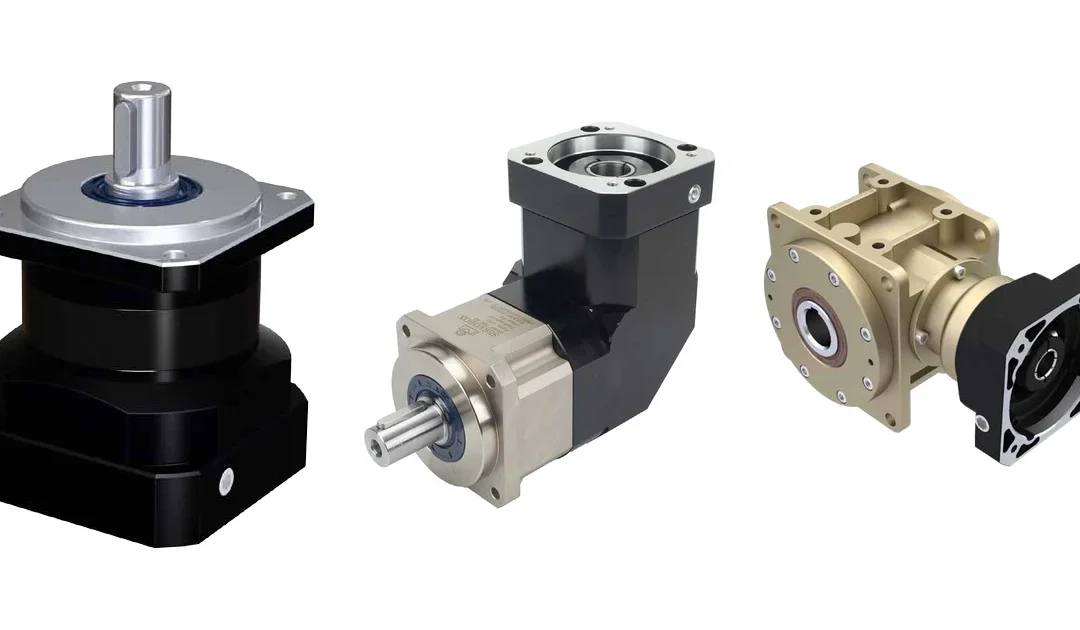
The servo motor provides the speed; the gearbox decides what reaches the mechanics — torque, accuracy and stiffness. Taiwanese manufacturer Li Ming covers the whole chain with three gearbox families: for servo axes, for right-angle and hollow drives, and for robot joints. Here is what they can do and how to choose.
1. SERVOBOX — planetary gearboxes for servo motors
- SB / SE — inline, with output shaft (SB) or flange (SE), frame sizes 44–220, rated torque T2N 13–2030 Nm in one stage, ratios 3–10 (1-stage) and 15–100 (2-stage).
- SD — high stiffness, backlash down to ≤ 1 arcmin in one stage (class Ps) — for rotary tables and precise positioning.
- SBL / SEL / SFL / SDL — right-angle, ratios up to 200 — when the motor must sit beside the axis.
- FABGEAR (SN, PB, FA, FB, FC…) — the economy line with ≤ 6–8 arcmin backlash: gantries, feeds, handling. FA: T2N 14–1060 Nm, rated input 3000 rpm, max. 5000 rpm.
Across the range: efficiency ≥ 97 % (1-stage) and ≥ 94 % (2-stage), IP67, lifetime lubrication, motor-specific flange and collet. Acceleration torque up to 1.8 × T2N, emergency stop torque 3 × T2N.
2. Right-angle and hollow gearboxes
- ST — spiral bevel, backlash ≤ 3 arcmin, up to 45 kW, efficiency 94–98 %; with a planetary stage — ratio up to 500.
- HY — hypoid, ratio up to 150, backlash ≤ 3 arcmin.
- HK / HF — hollow rotary tables: cables and air lines pass through the centre, backlash ≤ 3 arcmin.
- GT — precision, backlash ≤ 1 arcmin, efficiency ≥ 98 %.
3. Gearboxes for robots
- ROBONICDRIVE (harmonic / strain wave) — DSF/DSG (hat type) and DHG (cup type, also hollow), sizes 14–45, ratios 50–160, rated torque 7–408 Nm. Practically zero backlash, light and compact — for wrist and light joints, rotary modules and optics.
- CYKODRIVE (cycloidal, RV type) — RS, RD and RC (hollow shaft), sizes 6–450, rated torque 60–4500 Nm, ratios 41–171, backlash ≤ 1 arcmin (class Ps). They withstand 5 × rated torque at emergency stop and take high radial and axial loads directly on the flange — for robot base and arm, positioners and indexing tables.
How to choose — 6 steps
- Ratio from speeds: i ≈ nmotor / nload.
- Torque: cycle average ≤ T2N, acceleration ≤ T2B, emergency stop ≤ T2NOT.
- The motor must not overload the gearbox: motor peak torque × i ≤ T2B, otherwise limit the current in the servo drive.
- Inertia: reflected load inertia (J / i²) versus motor inertia — up to about 10:1 for dynamic axes.
- Backlash by accuracy: gantry and feed — 5–8 arcmin (FABGEAR); tables and positioning — ≤ 3 arcmin; robots and multi-axis systems — ≤ 1 arcmin.
- Mounting: inline, right-angle or hollow; radial and axial load on the output; flange to suit the motor (KBR reducing bushes adapt a smaller shaft).
Our free servo and gearbox sizing calculator covers steps 1–5 for Delta servo motors with SERVOBOX gearboxes.
In stock
FA050–FA120 planetary gearboxes for Delta ECMA servo motors (ratios 5–100), the right-angle SERVOBOX SBL90 (i = 10), the ROBONICDRIVE DHG17-AK harmonic gearbox (i = 50, 20 Nm rated) and KBR reducing bushes — see planetary gearboxes. For another series, size or flange, send us the motor and load data and we will propose a specific model. Data from the Li Ming SERVOBOX 06.2026, ROBONICDRIVE/CYKODRIVE and right-angle catalogues — li-ming.com.
Абонирайте се за седмичния бюлетин
1–2 новини в понеделник: нови продукти, проекти и технически материали — само когато има нещо ново.